The Problem
A torsion spring doesn't care about the calendar until the temperature drops, and then it cares a lot. We run calls across a wide stretch of this area, from Wormleysburg two miles out to Hershey thirteen miles east, and the spring problem looks different depending on which decade the house went up in. Housing here mostly dates from 1938 to 2004, with the median build year sitting around 1970, so a good chunk of the springs still on these doors are original or close to it. Steel fatigues with every open-and-close cycle, and a spring rated for ten thousand cycles doesn't know it's supposed to last fifty years just because nobody replaced it. What usually happens is the spring has been weakening for months, maybe years, and the first hard cold snap is what finally snaps it. You hear a bang, the door won't lift, and the opener strains against dead weight it was never built to carry alone. That's not bad luck. That's a spring that was already close to done, and cold weather just picked the day.
What Changes With the Season
Metal contracts as it cools, and a torsion spring under tension is already working against itself before the thermometer drops. In a climate band rated cold and severe, that contraction is real, not theoretical - the spring gets stiffer and less forgiving right as the coils are asked to do the same job they did in July. Lubricant thickens too, in the spring coils and in the bearing plates at each end, so the first full cycle of a cold morning asks more of a part that's already giving less. None of this shows up as a dramatic failure most of the year. It shows up as a slightly harder lift in November, a louder creak in December, and then a snapped coil on the coldest morning of January. If your door has felt heavier to lift by hand over the past month or two, that's the spring telling you what season it thinks it's in, and it's usually right before you are.
What to Look At First
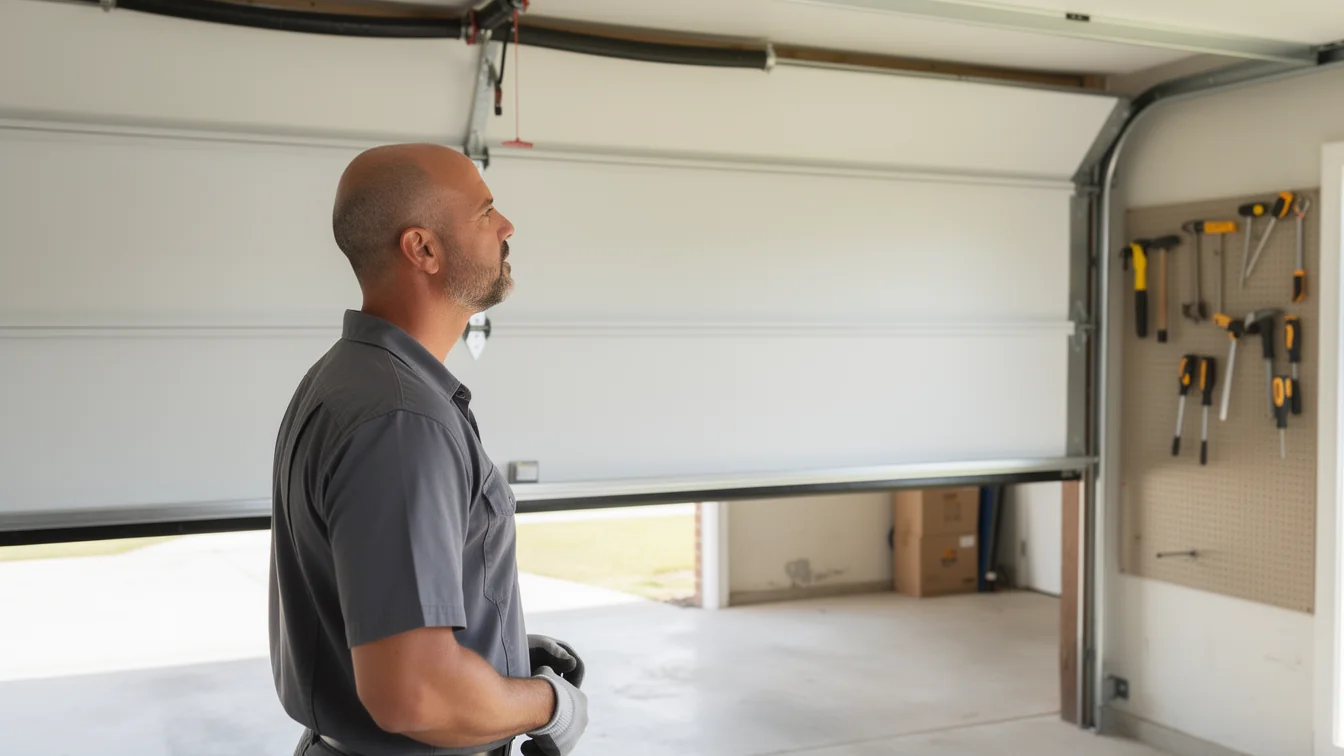
Start with the spring itself, not the opener. A visible gap in one of the coils means it's broken and the door shouldn't be run until it's fixed - forcing it through the opener motor just wears out the motor on top of the spring problem. If the coils look intact, check whether the spring is original equipment or already a replacement; houses built in the common local range of the 1960s and 70s often still carry side-mounted torsion hardware that doesn't match what's stocked off the shelf today, which affects how fast a repair can actually happen. Next, look at the cable drums on either end of the shaft - a spring under cold strain sometimes takes a cable with it, and a frayed or slipped cable is a separate, more dangerous repair than the spring alone. Last, listen to the opener. If it's straining and reversing instead of lifting cleanly, don't keep testing it. One honest limitation here: once a double door's spring has broken on one side, we replace both springs as a pair, not just the broken one, because the second one is on the same clock and nearly always follows within a season or two.
What the Weather Here Does to It
This area sits in a cold, severe climate band, and that classification isn't just a label - it's the difference between a spring that fails on a predictable schedule and one that fails on the coldest morning you weren't planning for. Overnight lows pull the moisture out of old grease and leave bearings running drier than they were designed to. Freeze and thaw cycles through the winter months work on more than just roads and foundations; they work on galvanized coating too, and once that coating is compromised the bare steel underneath corrodes faster with every freeze. A spring installed when a 1970-built house was new has already gone through four or five decades of winters like this, and the last bit of give in that metal tends to run out in January, not June. We can't stop a thirty-year-old spring from reaching the end of its cycle count. What we can do is replace it with hardware sized for the door it's actually on, instead of whatever happened to be standard the last time it was installed.
Talk to a local pro
Garage door trouble in Harrisburg?
Same-day service with honest, upfront quotes.